This article was originally written as a submission to the now-defunct Shut Up and Go Travel site.
“The system is down,” the cashier told me in English.
I’d started our conversation in Norwegian, but the middle-aged man in front of me sensed I wasn’t fluent and switched languages directly. To be fair, he was right, but I still would have liked the chance to make a fool of myself. “Oh,” I said. “Okay, takk.”
I was already pulling out my phone to search for the next-closest corner shop when he stopped me. “No, the whole system is down. It’s out for the entire city, and we don’t know why.” Oh.
For context, I was at a 7-Eleven in Oslo trying to buy a bus ticket. Not an unusual occurrence for Oslo, but a first for me. I was already on Plan B to get myself on some form of public transit and it wasn’t going well. Of course the hottest day of the year thus far was the day I couldn’t get a ticket.

I fell in love with Norway in 2017 during my last quarter at university, completely by accident. As the stress of an uncertain future began to take hold, I stumbled across a Norwegian web series (of all things) to distract myself from finals and life for a while. I could never have foreseen how much it would change my life. I became consumed by a language and culture which had, until then, been unknown to me, researching and absorbing as much as I could about this picturesque country east of the Atlantic.
I started teaching myself Norwegian as a personal challenge, constantly on the lookout for (free) study materials as I worked my way through various YouTube lessons, online grammar guides, and the Duolingo curriculum. My friends and family didn’t quite know what to make of this, as I am 0% Scandinavian—confirmed by AncestryDNA— and have been slogging through French classes on and off since elementary school. But I didn’t mind. Learning Norwegian was like a door opening up in my life, just as my time at university came to a close. It has been my most productive existential crisis to date.
Now, nearly a year after graduation, it had been only days since I’d stepped off a plane into the Oslo sunshine, the happiest I’d felt in a very long time. Life is ever changing, but the city under my feet was solid and real. As I stood on top of the opera house that first afternoon, I felt as if I’d finally come home.
For almost a week, I walked the intimate city streets, exploring bookstores, parks, and statue gardens. I had done my research and knew what I wanted out of this trip: to do some soul searching by exploring a city originally made real to me through fiction. I’d dropped virtual pins on Google Maps before arriving and methodically traversed the city on foot as I checked off destinations one by one. Some were filming locations used in the web series, others were from travel blog posts and lists I found online highlighting hidden gems and unique attractions. I wanted to breathe the city in, and I couldn’t remember the last time I’d felt so alive and in control.
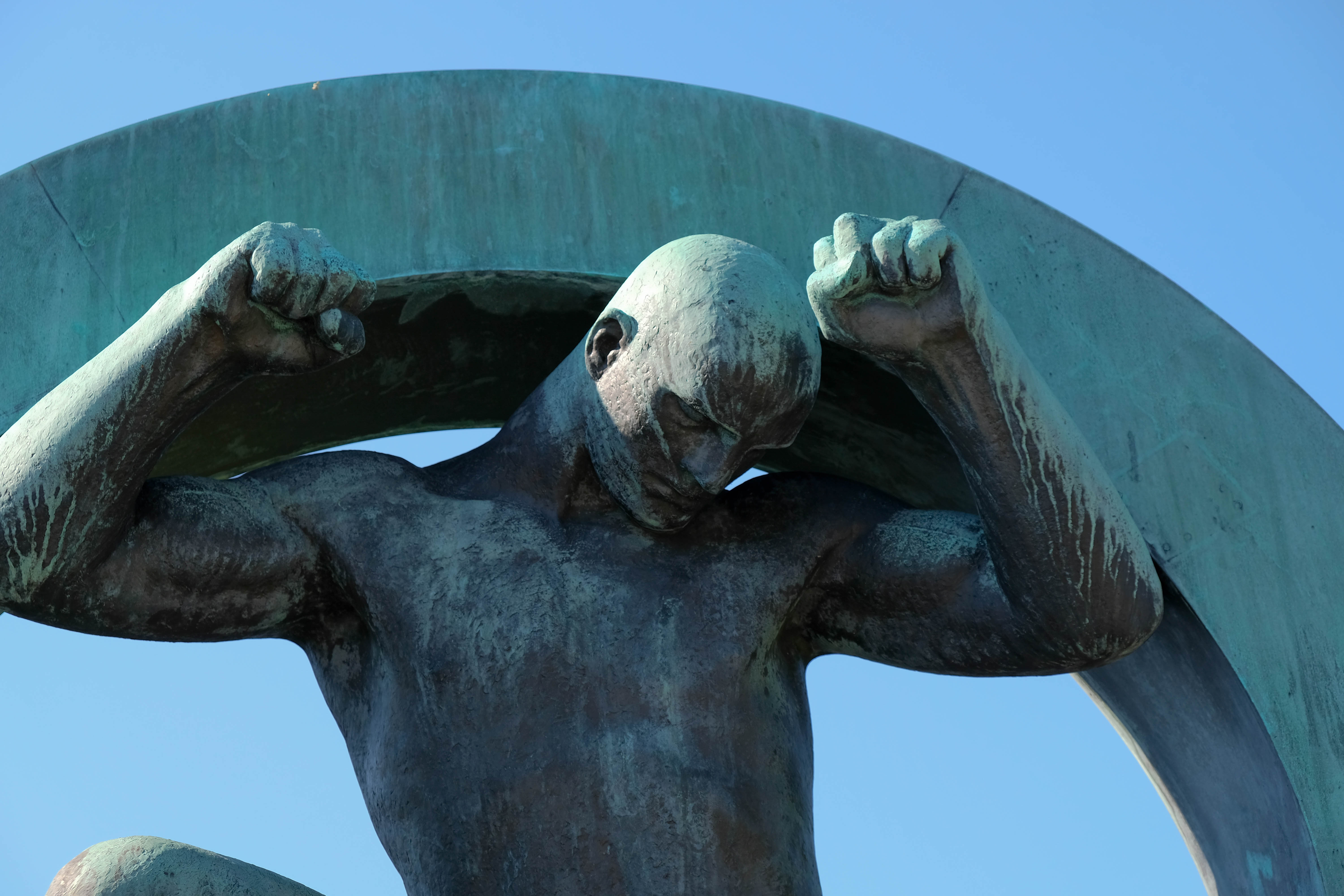
But my fourth day dawned hot, hotter than expected for mid-spring in northern Europe. It had been a strategic choice to travel in May, as I wanted to experience the festivities of 17. Mai (Norway’s constitution day), but the spring temperatures were also a deciding factor. I would leave navigating a Scandinavian winter for another time. But with all my planning, I wasn’t prepared for the heat wave that was about to roll in, peaking that day at nearly 80 degrees Fahrenheit.
By 11:00am, I could feel myself beginning to lag. The sun was sapping my energy and I was quite possibly dehydrated. I hadn’t packed for hot weather (which, in my defense, felt understandable for spring… in Norway), but there was still half a day to fill. The last item on my list was Bygdøy, a peninsula jutting out into the Oslo Fjord that is home to parks, forests, beaches, a royal estate, and five national museums. I specifically wanted to see the Gol stavkirke, the only stave church I would be able to see on my trip without access to a car, and it made the most sense to visit while I was already on the west side. It was time to take the bus.
I had been traveling exclusively on foot until that point, mostly because Oslo isn’t as large as some European capitals and it gave me maximum freedom to explore, but I will admit there was a small part of me that hadn’t wanted to screw up making the transaction. What if I used my ticket wrong? I did not want to look like a tourist, I was a traveler, dammit! But I knew it was time to get over myself and that my body would thank me for skipping the walk this time.
“And bus drivers can’t give me a ticket?” I asked the 7-Eleven cashier presently. I was told they could not.
“There’s an app…” the man continued, trying to give me options, but I already knew. I had tried the e-ticketing app, RutterBillet, from the bus stop 15 minutes prior, only to discover it didn’t accept American bank cards. I hadn’t been alarmed, though. I knew that individual tickets were sold at certain corner stores, and that there was one less than a quarter of a mile from the bus stop where I had been waiting. It was in the wrong direction, but I didn’t mind. What was an extra few steps if the payoff was a bus taking me the longer distance I still needed to go? So I’d set out. Turns out the city was conspiring against me.

The only other place I knew of to get a physical ticket was on the other side of the city, and since that wasn’t an option in that moment, I stood outside on the sidewalk to strategize. I really, really wanted to see Bygdøy. I was in Oslo and wanted to see all of it. Though the sun was high in the sky, Google Maps said it was only a 25 minute walk. So I thought, “Screw it,” and set out, back the way I had come. Was I a little dehydrated and exhausted? Yes. But will I only live once? Also yes. I was in love with a city, and these are the things you do for love.
In no time, I was away from the close-knit city streets and on Bygdøy Allé, a main road that turned into a heavily trafficked thoroughfare. I stopped passing shops and began to see embassy after embassy along my path. And then suddenly I was walking on a narrow sidewalk on what was basically an overpass to a massively busy freeway; behind me was Oslo’s quaint architecture while here was a clear example of modern afternoon traffic. The cars whizzed past, far too close, but I kept on, and after some light jaywalking, I found myself at a small harbor full of personal watercraft. If I hadn’t known about the roaring highway a few hundred meters away, it would’ve seemed as though I was in a secluded fjord town.
The sun was high as I took a sip of my water and then pushed on. In seconds, the noise of the city noticeably lessened as the sounds of birds and nature took over. It only took a few more steps before I found myself surrounded by… cows? I had come upon a grassy field, a rolling pasture a stone’s throw from the city. I wanted to laugh with utter joy. A quarter-mile behind me was a bustling metropolis, while before me was lush farmland butting up to the edge of a forest. I was in Oslo!

I paused to rest in the shade just before the city disappeared behind a bend in the road. The bus I should have been on whizzed by carrying ticket-holding passengers, taunting me. I squared my shoulders and continued. I was surrounded by wooded fields and I was in Oslo.
Eventually, the stavkirke came into view among the trees, which felt like a small victory until I saw the fence rising between me and it. I would have to find my way to the entrance of the Norsk Folkemuseum, much farther down the road, in order to get to the building itself. My stomach dropped, but I figured if I was going to pass out from the heat, I might as well do it in front of a stave church. So I kept walking.
After what felt like hours, with my shirt beginning to stick to my back, the road opened up, the trees thinning to give way to a populated little main street. One of the first buildings was the entrance to Norsk Folkemuseum, and the relief I felt was almost comical. I spent a few minutes in the attached cafe to eat something and regroup before going back the way I had come, this time through the museum, to find the stave church.
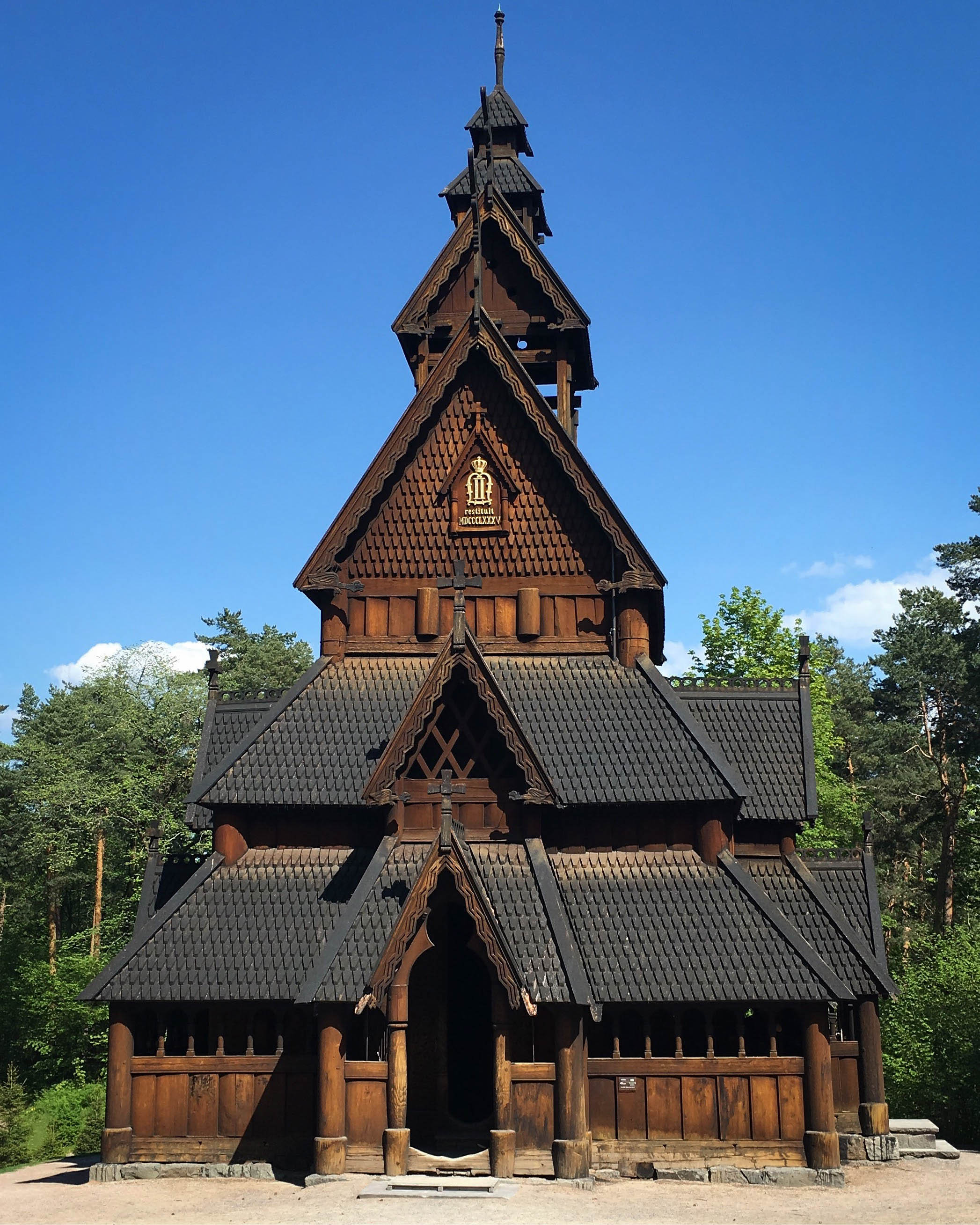
It was every bit as impressive as it had seemed behind the gate. Situated on top of a small hill (because of course there was another hill), the trees parted into a large clearing, and the tiered structure soared up above me, the sunlight catching on the dark wood. The stavkirke was immense in an understated way, and I could immediately understand why they were once used as places of worship. It was a building with presence, a presence I felt as I stepped out of the sun and into its dark interior. I was so glad I hadn’t skipped Bygdøy, if only for this moment.
But as I made my way slowly back towards the museum’s exit to the street, I could feel dread rising within me at the prospect of more walking. Even if I returned directly to my hostel, I’d still have to go all the way back to Oslo-proper and then continue through it to the east side of the city. I was already so hot and so tired, stuck in long pants as the temperature rose higher and higher. Trying to keep the pleading out of my voice, I asked the woman behind the museum’s ticket counter if there was really no way to get myself on public transit. She looked skeptical.
“It’s more expensive, but if you have cash—”
“I have cash!” I may have been a tad overenthusiastic.
“If you have cash, you can give it to the bus driver and they’ll let you on.”
I sagged with relief. Outside, I approached the bus stop with a new spring in my step. Finally, the chance to get off my feet and get back into town.
But… why not go a little further? I was already here. I was in Oslo.
I got onto the bus headed away from town and towards the beach, passing the driver some kroner bills. “Huk stranden?” I asked.
She handed me a ticket.
And off I went.
 Maya Kanga